
'Anybody who speaks up, anybody who reports something that the government feels uncomfortable with, or comments on anything could be charged with criminal cases, could be summoned to police stations, slapped around or grilled for several hours. This has become a new norm.'
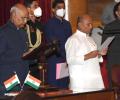
'Nitish Kumar was not happy about promoting R C P Singh as Union minister.'
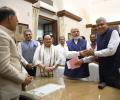
When Mukhtar Abbas Naqvi's name was floated as Venkaiah Naidu's successor as vice president, the RSS instead suggested Jagdeep Dhankar, indicating that he was also Mohan Bhagwat's choice, states Prakash Bhandari.

At its Jaipur meeting, the BJP will focus on this year's assembly elections in Gujarat and Himachal Pradesh while the Congress's Chintan Shivir in Udaipur will discuss how it can resurrect itself.
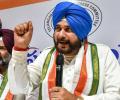
'His past as a cricketer makes it difficult for the BJP to question his nationalism.' 'He gets away by ridiculing Modi while something similar from most Congress leaders does not resonate as much.'

'When Sachin Tendulkar bats, no one in India cares if he is from Mumbai or if he is a Hindu or a Brahmin or whatever.' 'We just want him to win it for India.' 'The same is with Modi and the people who voted across caste and regional lines for him.' We want him to win it for India,' says Madhu A K.

'At this moment, the Trinamool has an edge.'

'This was Indian land the PLA advanced on and occupied.' 'The Chinese then 'negotiated' a pullback of their troops a small distance on Indian territory even as Indian jawans draw back further into India from the forward position.' 'An apparently satisfied Indian government says this is a great move for peace! How great is that for China!'

Rediff.com's Syed Firdaus Ashraf traces the journey of PM-CARES from its founding to finally admitting it is not a government fund.
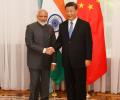
'The fact that Modi and Xi exuded confidence to accelerate the negotiations for a border settlement alone underscores that the Russia-India-China triangle has become very dynamic,' notes Ambassador M K Bhadrakumar.

The appointments to the Supreme Court and the high courts cannot be speeded up unless both the Judiciary and the Executive agree to a new mechanism which affords both near-parity in decision-making, argues Virendra Kapoor.
